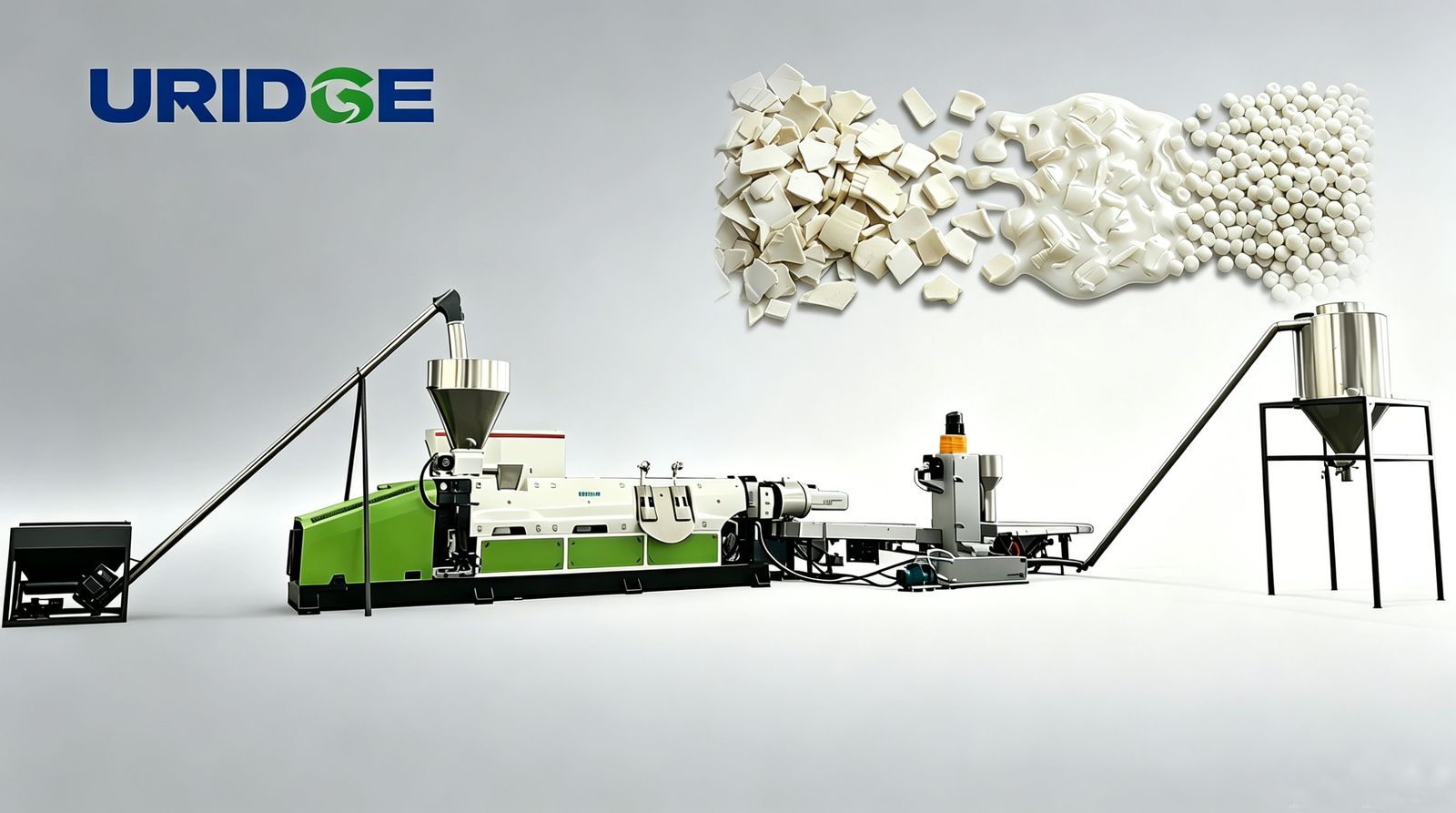
Plastic Pelletizing Line
Waste Rigid Plastic Pelletizing Line
URIDGE builds rigid plastic pelletizing lines for HDPE, PP, ABS, PC and PA, with 100–1000 kg/h capacity and configurable filtration and pelletizing systems.
- Turnkey design & installation
- ISO9001 / CE certified
- 24/7 global after-sales support
Product Overview
The URIDGE Waste Rigid Plastic Pelletizing Line recycles rigid thermoplastic waste into reusable plastic granules. It is designed for processed rigid materials such as HDPE, PP, ABS, PC and PA from plastic pipe production, injection molding, sheet production and other plastic processing operations, as well as post-industrial plastic recycling.
The main production platform is standardized, while key process sections — including screw configuration, vacuum degassing, melt filtration and pelletizing — are selected according to the material, contamination level, required output and final pellet quality. The standard production series covers nominal capacities from 100 kg/h up to 1,000 kg/h.
Suitable Materials and Applications
The line is mainly designed for shredded or crushed rigid thermoplastic waste. Typical materials include HDPE, PP, ABS, PC and PA. Typical applications cover production waste from plastic pipe factories, sheet extrusion plants, injection molding factories and other plastic processing operations, as well as rigid plastic recycling facilities.
Large or bulky plastic waste can be pre-processed by shredding and crushing before it enters the pelletizing line. PET and thermosetting plastics are not intended for this system.
Recycling and Pelletizing Process
Typical process flow: bulk plastic waste → shredding → crushing → feeding → extrusion and melt mixing → vacuum degassing → melt filtration → water-ring pelletizing → cooling → dewatering → pellet screening → pneumatic conveying → storage.
Shredding and Crushing
Large rigid plastic pieces can first be reduced by a shredder and crusher to prepare a suitable feed size for stable extrusion.
Feeding and Extrusion
The feeding system transfers prepared material into the extruder, where the plastic is melted and mixed into a stable polymer melt before degassing and filtration.
Vacuum Degassing
The vacuum system removes moisture, volatile gases and other components released from the polymer melt during processing.
Melt Filtration
The melt filtration system removes solid contamination before pelletizing; the configuration is selected according to the contamination level and required pellet quality.
Pelletizing
Water-ring pelletizing is the standard configuration. Depending on the polymer and process requirements, strand pelletizing or underwater pelletizing can also be configured.
Cooling, Dewatering and Screening
After pelletizing the granules are cooled and dewatered, and a vibrating screen separates oversized and undersized granules to improve pellet size consistency before the finished pellets are pneumatically conveyed to the storage silo.
Standard Line Configuration
A typical Waste Rigid Plastic Pelletizing Line includes: feeding system, extruder, vacuum degassing system, melt filtration system, water-ring pelletizing system, cooling system, centrifugal dewatering system, vibrating screen, pneumatic conveying system and storage silo. For large or bulky feedstock, shredding and crushing equipment can be added as upstream preprocessing.
Flexible Melt Filtration Options
Different feedstocks require different filtration strategies. URIDGE can configure filtration systems including plate screen changers, column-type screen changers, CPF filtration, screenless filtration, laser filtration and automatic backflush filtration. A melt pressure sensor can be installed upstream of the filtration system to monitor pressure and filter loading, and automatic discharge or screenless options can reduce manual screen replacement for higher-automation applications.
Automation and Process Control
The line can be equipped with a Siemens PLC and an HMI operator interface. PID temperature control maintains processing temperature across the extrusion system, and melt pressure can be linked with the feeding system and main drive to help keep extrusion pressure stable. The control system can also include motor protection, recipe storage and remote monitoring. With customer authorization, the network module can support remote diagnostics and software adjustment across regions.
URCS Series Technical Specifications
| Model | Screw Dia. | L/D | Nominal Capacity | Installed Power | Dimensions (L×W×H) |
|---|---|---|---|---|---|
| URCS 85 | 85 mm | 36:1 | 100–150 kg/h | 140 kW | 12.5 × 3.0 × 2.8 m |
| URCS 100 | 100 mm | 36:1 | 150–250 kg/h | 175 kW | 13.5 × 3.0 × 2.8 m |
| URCS 120 | 120 mm | 36:1 | 250–350 kg/h | 210 kW | 14.5 × 3.2 × 3.0 m |
| URCS 140 | 140 mm | 36:1 | 350–550 kg/h | 245 kW | 16.0 × 3.2 × 3.0 m |
| URCS 160 | 160 mm | 36:1 | 550–750 kg/h | 315 kW | 18.0 × 3.5 × 3.2 m |
| URCS 180 | 180 mm | 36:1 | 750–1000 kg/h | 380 kW | 20.0 × 3.5 × 3.2 m |
Notes:
- Capacities are nominal values and may vary according to polymer type, feed condition, contamination level, filtration configuration and pelletizing method.
- Water-ring pelletizing is the standard configuration; strand or underwater pelletizing can be configured according to application requirements.
- Customized configurations are available for screw design, vacuum degassing, melt filtration, electrical standards, automation and downstream equipment.
Flexible Configuration
Although based on standardized production models, key process sections can be configured to the customer's application. Configurable items can include screw configuration, vacuum degassing, melt filtration, pelletizing method, production capacity, electrical specification, automation level and plant layout. For example, a Roots-type vacuum system can be selected when stronger degassing is required. Filtration and pelletizing are chosen according to material characteristics, contamination level and final pellet requirements.
Pellet Quality
The system is designed to produce recycled granules with consistent pellet size, stable shape and reduced contamination. Final pellet quality depends on incoming material condition, preprocessing, degassing, filtration accuracy and process settings.
Factory Testing
The production line can be tested with material before shipment. Customers can also supply their own feedstock for trial production so that machine configuration and processing conditions can be evaluated before delivery.
Installation and Technical Support
URIDGE provides installation, commissioning, operator training and spare-parts support, with remote technical support for troubleshooting and process adjustment. For selected components, locally available parts can be considered during machine configuration to simplify future maintenance. Typical warranty period: 1 year; typical production lead time: approximately 2 months; typical installation period: approximately 1 week.
Project Experience
URIDGE has supplied rigid plastic recycling and pelletizing equipment for customers in markets including Peru, Brazil, Nigeria, Turkey and Russia. Applications include production-waste recovery and rigid plastic recycling for plastic processing companies, pipe manufacturers, injection molding operations and recycling businesses.
Frequently Asked Questions
What materials can this pelletizing line process?
It can be configured for rigid thermoplastics such as HDPE, PP, ABS, PC and PA. Screw, degassing, filtration and pelletizing configurations are selected according to the specific polymer and feed condition.
What is the available production capacity?
The standard URCS model range covers nominal capacities from approximately 100 to 1,000 kg/h. Actual output depends on the material and process configuration.
What filtration systems are available?
Options include plate screen changers, column-type filters, CPF filtration, screenless filtration, laser filtration and automatic backflush filtration.
How is moisture removed from the melt?
A vacuum degassing system removes moisture and volatile components released during extrusion.
Which pelletizing method is normally used?
Water-ring pelletizing is the standard configuration; strand or underwater pelletizing can also be selected according to material and production requirements.
Can the line be customized?
Yes. Screw configuration, vacuum system, filtration, pelletizing method, electrical specification, automation level and line layout can be selected according to your production requirements.
Tell Us About Your Material
To configure a suitable pelletizing line, please send us: material type, feed form and size, contamination level, required output, required pellet quality, available factory space, and local voltage and frequency. URIDGE will recommend a machine configuration based on your actual production requirements.
Machine Video
Technical Specifications
Detailed parameters (capacity, screw diameter, installed power, dimensions, voltage) are tailored to your material and output requirement.
Request Spec Sheet Get a QuoteRelated Products
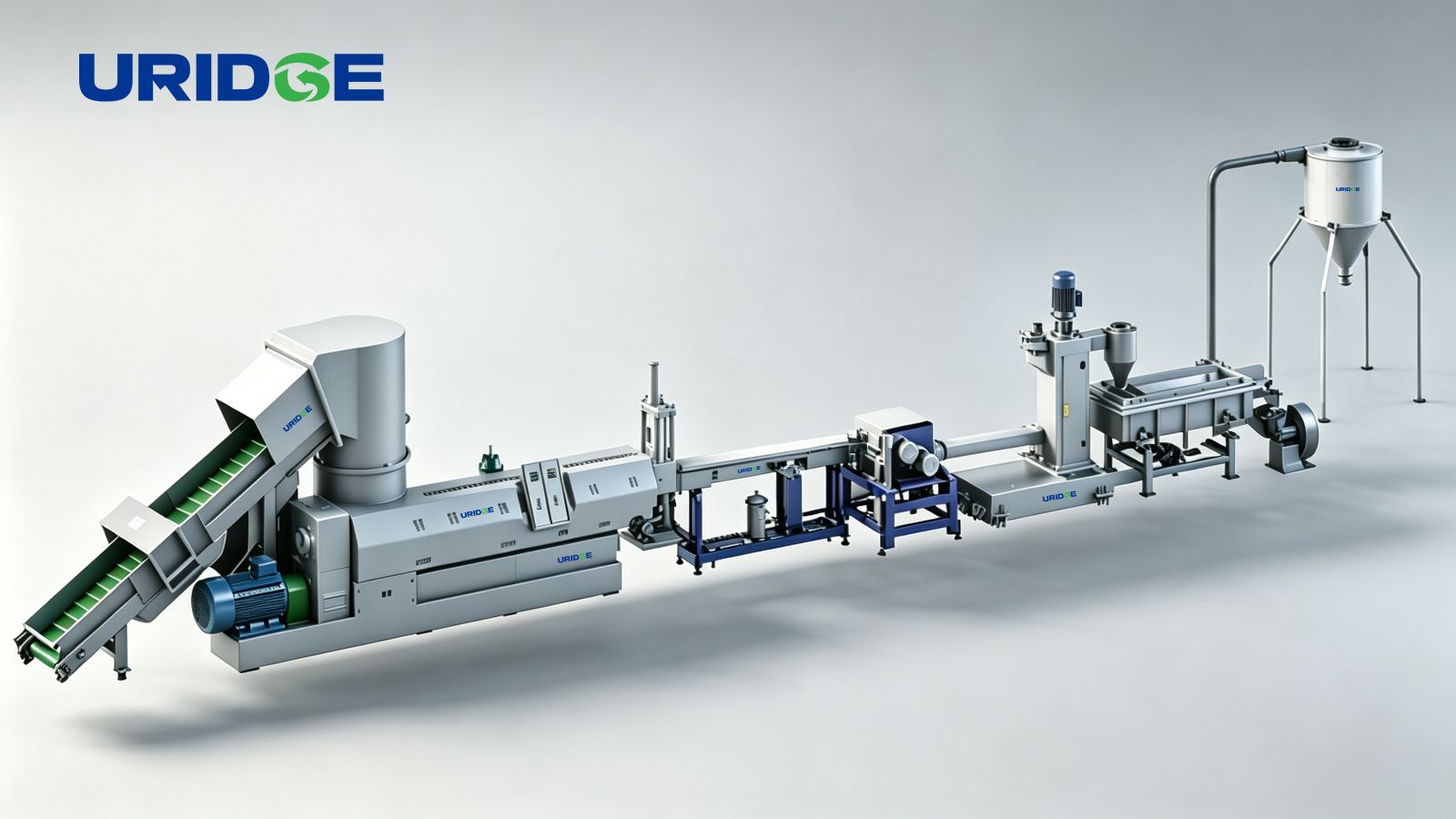
Plastic Pelletizing Line
Compaction Pelletizing System
URIDGE builds compaction pelletizing systems for film, woven bags, PET fiber and EPS foam, with 100–1,000 kg/h capacity and flexib…
View details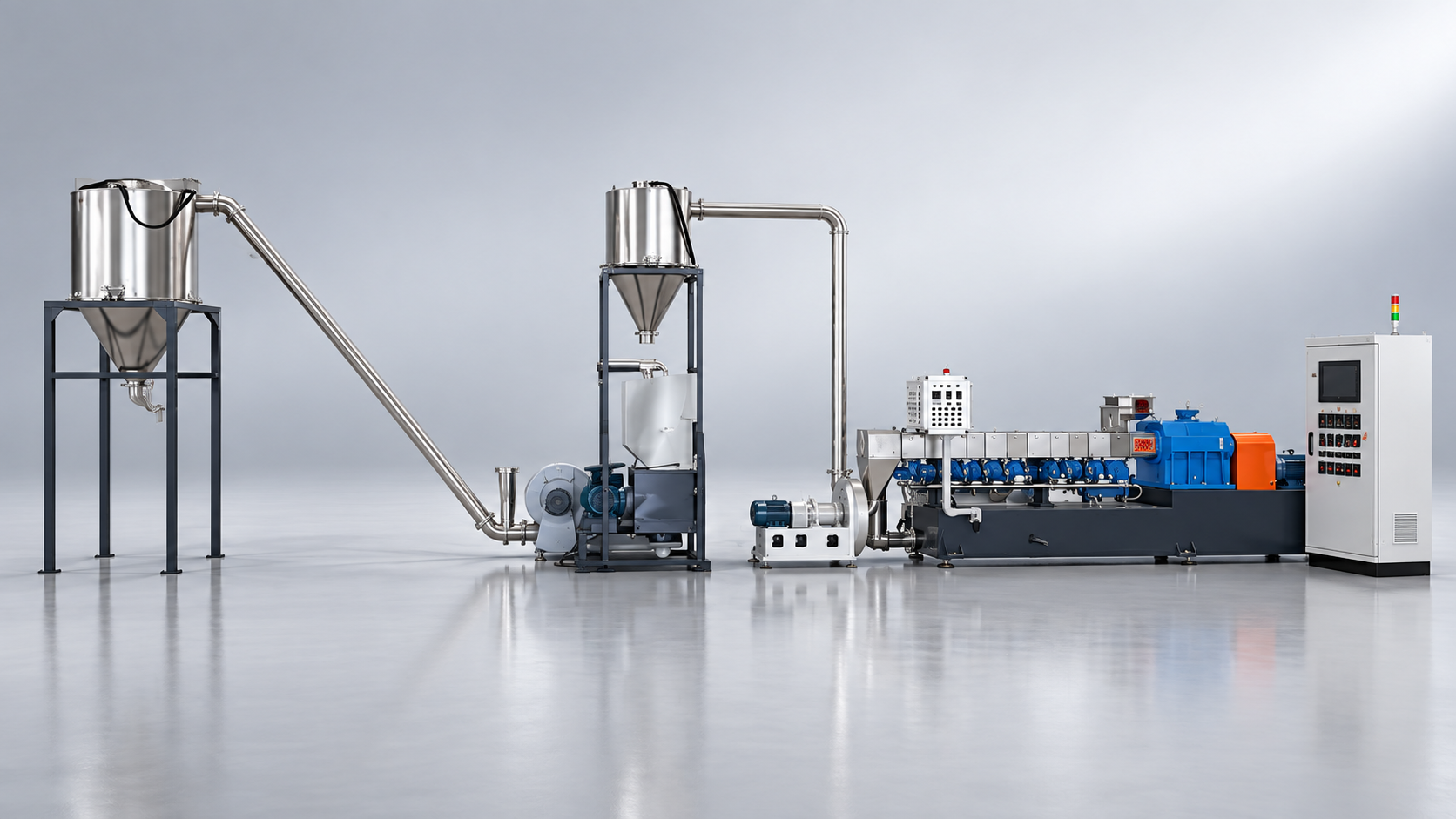
Plastic Pelletizing Line
WPC Pelletizing Line for Wood-Plastic Compounds
URIDGE builds WPC pelletizing lines for PE- or PVC-based wood-plastic compounds, using counter-rotating parallel twin-screw extrus…
View detailsReady to Upgrade Your Production Line?
Contact us today for a free consultation and a tailored solution.