Company News

Why 3D Rainscreen Mats Matter in Modern Wall Construction

A 3D rainscreen mat creates a continuous drainage and ventilation space behind exterior cladding. This article explains how the layer works, which product properties matter, and how extrusion and forming conditions influence finished-mat performance.
Why 3D Rainscreen Mats Matter in Modern Wall Construction

Exterior walls are expected to do more than keep rain away from the interior. They must also manage water that passes through joints, moves around openings or reaches the back of the cladding during wind-driven rain. A three-dimensional rainscreen mat gives this incidental water a defined route to drain while maintaining an open space that can support drying.

The principle is straightforward, but the performance of the finished mat depends on more than its nominal thickness. Filament diameter, open volume, compressive recovery, backing-fabric bond and profile consistency all influence how the drainage space behaves after the product is installed. For manufacturers, this makes the extrusion and forming process just as important as the raw material itself.

A Drainage Space Behind the Cladding

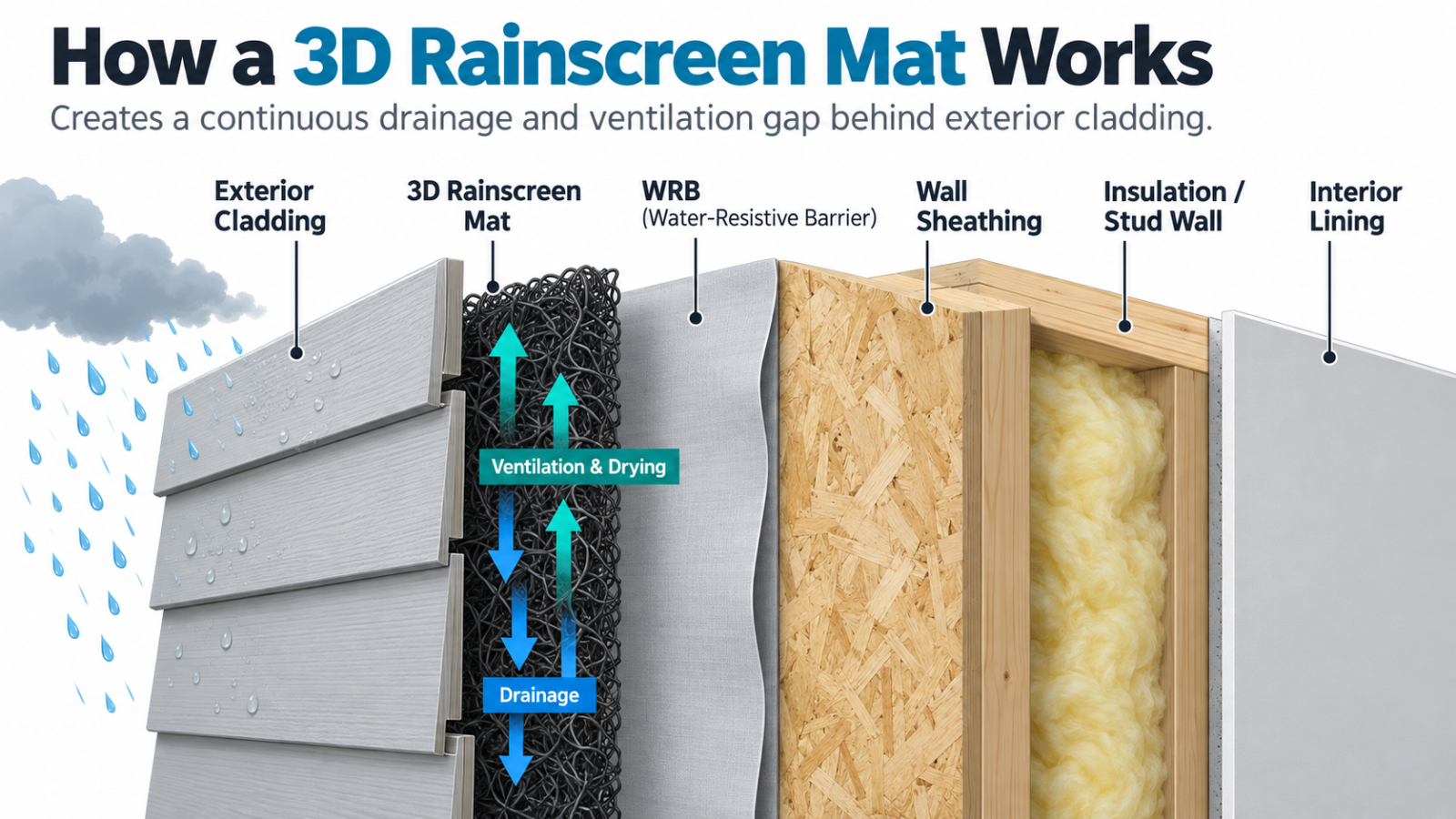
A typical drained wall includes exterior cladding, a drainage and ventilation gap, a water-resistive barrier (WRB), wall sheathing and the supporting wall structure. The 3D rainscreen mat is installed between the cladding and the WRB. Its entangled-filament structure separates the two surfaces and helps preserve a continuous cavity.

When rain reaches the back of the cladding, gravity carries the water down through this cavity to flashing and drainage openings. Air movement within the same space can help remove moisture that remains on the surfaces after bulk water has drained.

The distinction between these layers matters. A rainscreen mat is not the wall's waterproof membrane, and it does not replace the WRB or correctly integrated flashing. It provides physical separation and an open drainage path. The complete wall still depends on properly detailed windows, penetrations, transitions and base-of-wall outlets.
ChatGPT 图像 2026年10月11日 17 11 36

Why the Open Structure Must Remain Stable

A drainage mat can look open when it leaves the production line and still perform differently after it is fastened behind cladding. Installation pressure, fastener spacing and the weight of the exterior finish can compress the structure. If the mat does not recover sufficiently, parts of the drainage path may become restricted.

This is why product evaluation should consider the structure under load, rather than relying only on free-state thickness. The relevant properties normally include:

  • Nominal thickness: the designed separation between the cladding and the drainage plane.
  • Open volume: the space available for downward drainage and air movement.
  • Compressive resistance and recovery: the ability to retain or recover the profile after installation pressure.
  • Filament distribution: the uniformity of the entangled network across the full product width.
  • Backing stability: the integrity of the carrier fabric and its bond to the polymer structure.
  • Dimensional consistency: stable width, thickness and roll formation during continuous production.

More polymer does not automatically create a better mat. Excessive filament density can reduce open space and add weight, while insufficient density may result in poor support and uneven compression. The practical target is a stable structure that maintains the required drainage space with an efficient amount of material.
ChatGPT 图像 2026年10月11日 17 12 20

How Extrusion Conditions Affect the Finished Mat

Rainscreen mats are produced by extruding multiple molten polymer strands and laying them into a controlled three-dimensional arrangement. The strands contact one another while still hot enough to form a connected network. Cooling then fixes the structure before downstream handling and winding.

Several parts of the line have a direct effect on product consistency.

Melt Stability and Filament Diameter

Stable melt temperature and pressure are necessary to maintain consistent filament diameter. Large pressure variation can produce heavy and light areas across the web, affecting both basis weight and compression behaviour. Screw design, temperature control, screen condition and material feeding therefore need to work as one system.

Die Distribution Across the Working Width

On a wide line, uniform flow distribution becomes particularly important. A product can meet its average weight target while still having weak edges or a dense centre. Die balance, hole condition and the distance between the die and forming section must be controlled across the entire width.

Forming Rollers and Profile Geometry

The forming rollers determine how the hot filaments are supported, redirected and cooled. Changing the roller geometry can create different channel patterns, surface profiles and mat thicknesses. An interchangeable roller system allows a manufacturer to develop several structures on the same extrusion platform, provided the die, cooling and downstream settings remain compatible.

Cooling and Line-Speed Balance

The mat must be cooled enough to retain its shape without making the process unnecessarily long. If the structure is still too soft when tension is applied, it may stretch or flatten. If cooling is excessive or uneven, internal stress and roll-quality problems can develop. Extrusion output, forming speed, cooling capacity and winding tension must therefore be balanced rather than adjusted independently.

Backing-Fabric Integration

Some products use a nonwoven carrier or filter layer. The backing can help with handling, installation or application-specific filtration, but it also introduces another process variable. The bond must be secure without closing the open channels or causing distortion across the width.
ChatGPT 图像 2026年10月11日 17 12 28

PP and PA Are Not Processed in the Same Way

Polypropylene is widely used for entangled drainage mats because it is lightweight, moisture resistant and suitable for continuous extrusion. Selected polyamide materials can also be used when the product requires a different balance of stiffness, resilience or temperature performance.

A change from PP to PA is not a simple resin substitution. Polyamide is more moisture-sensitive and normally requires controlled drying before extrusion. Processing temperatures, cooling conditions and line speed may also need to change. The production line should be configured around the actual polymer grade and finished-product requirement rather than a generic material name.

Wide Production Lines Need Cross-Web Control

Increasing product width can improve output and reduce the number of seams needed during downstream conversion, but it also makes cross-web consistency more difficult. Melt distribution, filament laydown, cooling and winding tension must remain uniform from one edge to the other.

URIDGE addressed these points in a 2.2-metre PP rainscreen mat extrusion project installed in Seattle, USA. The line was designed for a nominal output of approximately 300 kg/h and used interchangeable forming rollers to produce different entangled-filament profiles. Its configuration brought extrusion, filament formation, structured roller forming, cooling, edge control, backing handling and winding into one production system.

2.2 m PP Rainscreen Mat Extrusion Line – Seattle, USA | URIDGE

What Manufacturers Should Define Before Ordering a Line

A useful equipment proposal starts with the finished product. Before selecting the extruder and downstream configuration, the manufacturer should define:

  • polymer grade and use of recycled or filled material;
  • finished width, thickness and basis weight;
  • required channel or surface pattern;
  • target compression and recovery characteristics;
  • backing-fabric type and bonding requirement;
  • roll diameter, roll weight and winding method;
  • target output and acceptable changeover time; and
  • applicable fire, façade and building-code requirements in the destination market.

Product samples are especially valuable. A sample gives the equipment supplier a physical reference for filament structure, thickness, backing and flexibility. Trial production with the customer's intended material can then be used to confirm a realistic operating window.

Installation Details Still Decide Wall Performance

Good mat production cannot compensate for poor wall detailing. The drainage path must remain continuous, and water must be directed out through correctly integrated flashing and drainage or weep openings. Sealant, mortar and incompatible fasteners should not block the cavity. Openings may also require insect protection that preserves both drainage and airflow.

The wall designer remains responsible for verifying fire performance, wind resistance, structural attachment, cladding compatibility and local code compliance. The mat is one component of the wall assembly, and its performance should be evaluated together with the WRB, insulation, flashing, fasteners and exterior finish.

From a Simple Spacer to an Engineered Product

A 3D rainscreen mat may appear to be a simple plastic mesh, but repeatable performance requires controlled polymer processing and careful wall-system integration. The most useful products combine an open drainage path with stable compression behaviour, consistent cross-web structure and reliable downstream handling.

For manufacturers, the opportunity is not limited to producing one fixed profile. A correctly configured extrusion line can support different mat thicknesses, filament densities, backing combinations and roller-defined structures. This flexibility is valuable when supplying several cladding systems or adapting products for different regional construction practices.

URIDGE configures entangled-filament extrusion systems around the customer's material, working width, target structure and output. Learn more about our related 3D and 4D entangled-filament extrusion platform, or contact our engineering team with a product sample and specification for a project-specific evaluation.

Ready to Upgrade Your Production Line?

Contact us today for a free consultation and a tailored solution.

Chat with us on WhatsApp Why 3D Rainscreen Mats Matter in Modern Wall Construction | URIDGE

Company News

Why 3D Rainscreen Mats Matter in Modern Wall Construction

A 3D rainscreen mat creates a continuous drainage and ventilation space behind exterior cladding. This article explains how the layer works, which product properties matter, and how extrusion and forming conditions influence finished-mat performance.

Why 3D Rainscreen Mats Matter in Modern Wall Construction

Exterior walls are expected to do more than keep rain away from the interior. They must also manage water that passes through joints, moves around openings or reaches the back of the cladding during wind-driven rain. A three-dimensional rainscreen mat gives this incidental water a defined route to drain while maintaining an open space that can support drying.

The principle is straightforward, but the performance of the finished mat depends on more than its nominal thickness. Filament diameter, open volume, compressive recovery, backing-fabric bond and profile consistency all influence how the drainage space behaves after the product is installed. For manufacturers, this makes the extrusion and forming process just as important as the raw material itself.

A Drainage Space Behind the Cladding

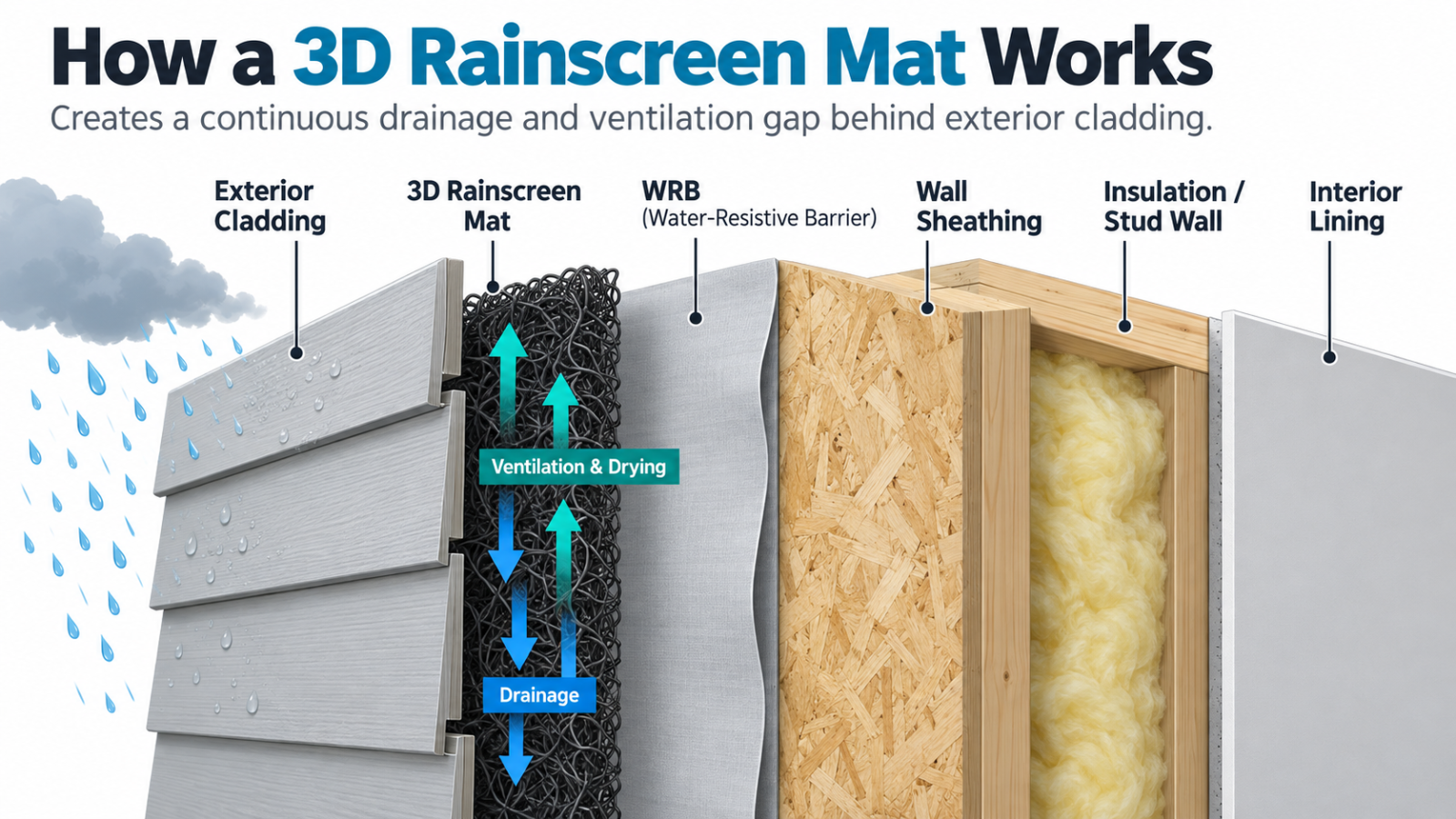
A typical drained wall includes exterior cladding, a drainage and ventilation gap, a water-resistive barrier (WRB), wall sheathing and the supporting wall structure. The 3D rainscreen mat is installed between the cladding and the WRB. Its entangled-filament structure separates the two surfaces and helps preserve a continuous cavity.

When rain reaches the back of the cladding, gravity carries the water down through this cavity to flashing and drainage openings. Air movement within the same space can help remove moisture that remains on the surfaces after bulk water has drained.

The distinction between these layers matters. A rainscreen mat is not the wall's waterproof membrane, and it does not replace the WRB or correctly integrated flashing. It provides physical separation and an open drainage path. The complete wall still depends on properly detailed windows, penetrations, transitions and base-of-wall outlets.

ChatGPT 图像 2026年10月11日 17 11 36

Why the Open Structure Must Remain Stable

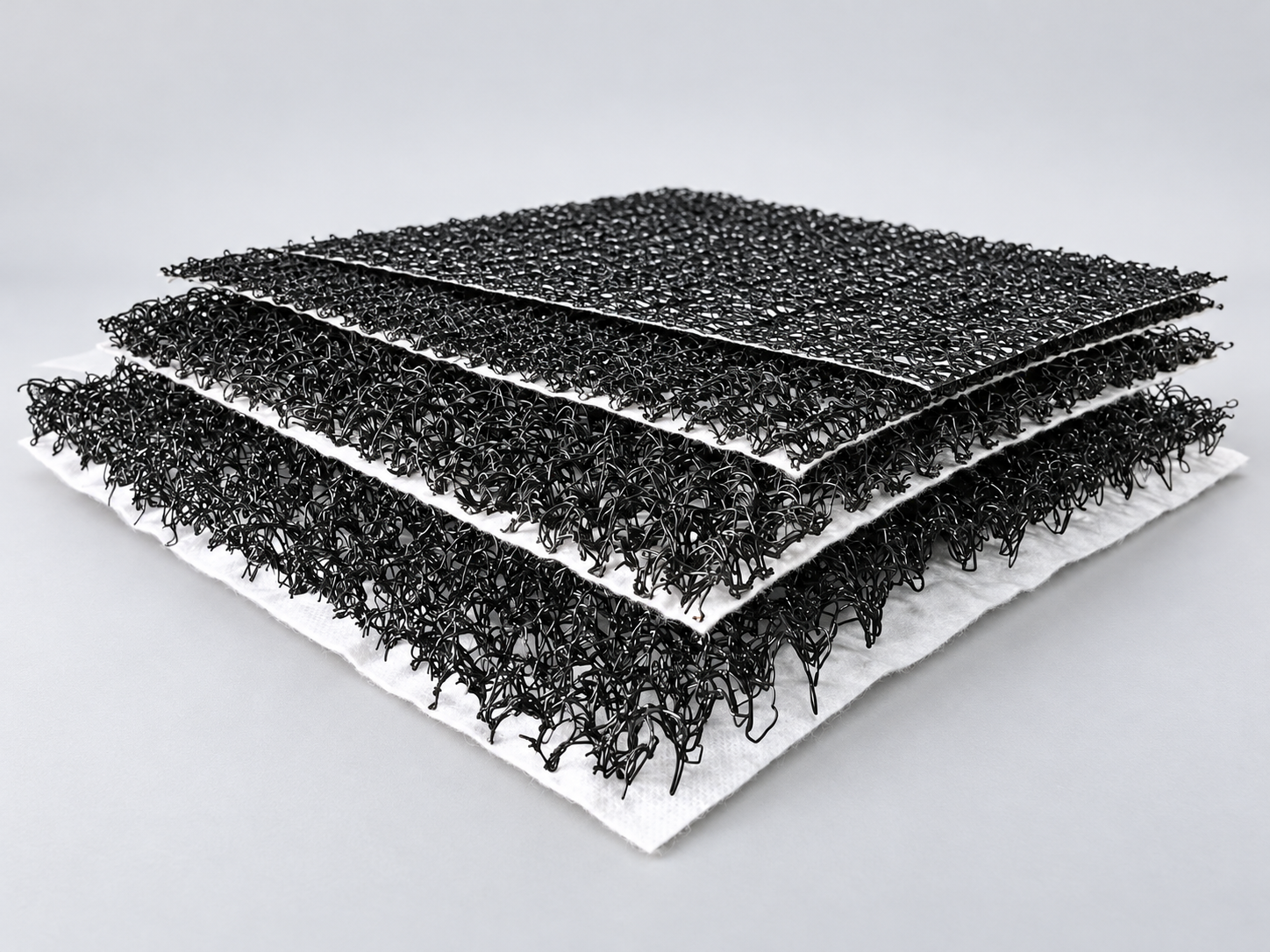
A drainage mat can look open when it leaves the production line and still perform differently after it is fastened behind cladding. Installation pressure, fastener spacing and the weight of the exterior finish can compress the structure. If the mat does not recover sufficiently, parts of the drainage path may become restricted.

This is why product evaluation should consider the structure under load, rather than relying only on free-state thickness. The relevant properties normally include:

  • Nominal thickness: the designed separation between the cladding and the drainage plane.
  • Open volume: the space available for downward drainage and air movement.
  • Compressive resistance and recovery: the ability to retain or recover the profile after installation pressure.
  • Filament distribution: the uniformity of the entangled network across the full product width.
  • Backing stability: the integrity of the carrier fabric and its bond to the polymer structure.
  • Dimensional consistency: stable width, thickness and roll formation during continuous production.

More polymer does not automatically create a better mat. Excessive filament density can reduce open space and add weight, while insufficient density may result in poor support and uneven compression. The practical target is a stable structure that maintains the required drainage space with an efficient amount of material.

ChatGPT 图像 2026年10月11日 17 12 20

How Extrusion Conditions Affect the Finished Mat

Rainscreen mats are produced by extruding multiple molten polymer strands and laying them into a controlled three-dimensional arrangement. The strands contact one another while still hot enough to form a connected network. Cooling then fixes the structure before downstream handling and winding.

Several parts of the line have a direct effect on product consistency.

Melt Stability and Filament Diameter

Stable melt temperature and pressure are necessary to maintain consistent filament diameter. Large pressure variation can produce heavy and light areas across the web, affecting both basis weight and compression behaviour. Screw design, temperature control, screen condition and material feeding therefore need to work as one system.

Die Distribution Across the Working Width

On a wide line, uniform flow distribution becomes particularly important. A product can meet its average weight target while still having weak edges or a dense centre. Die balance, hole condition and the distance between the die and forming section must be controlled across the entire width.

Forming Rollers and Profile Geometry

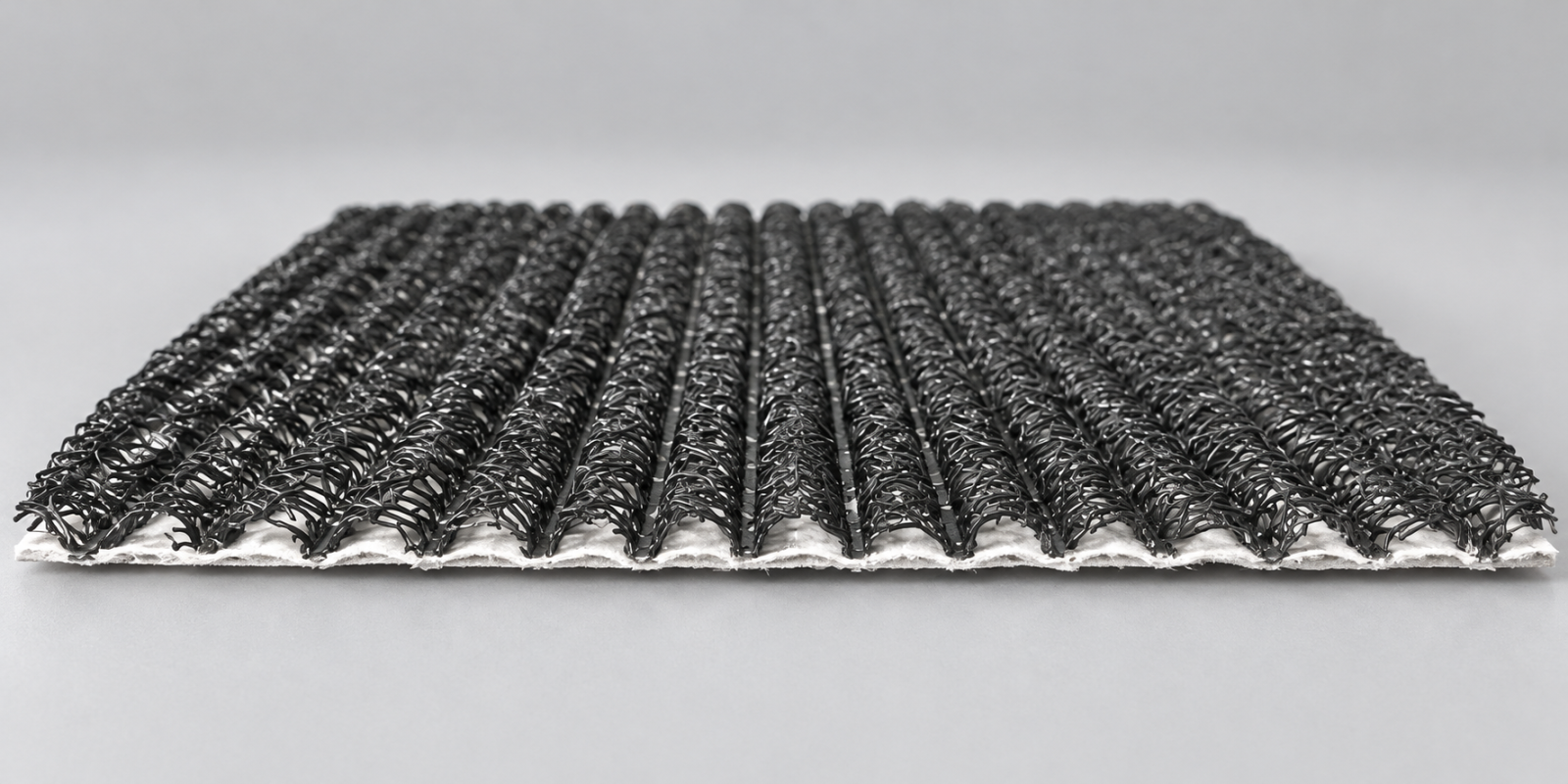
The forming rollers determine how the hot filaments are supported, redirected and cooled. Changing the roller geometry can create different channel patterns, surface profiles and mat thicknesses. An interchangeable roller system allows a manufacturer to develop several structures on the same extrusion platform, provided the die, cooling and downstream settings remain compatible.

Cooling and Line-Speed Balance

The mat must be cooled enough to retain its shape without making the process unnecessarily long. If the structure is still too soft when tension is applied, it may stretch or flatten. If cooling is excessive or uneven, internal stress and roll-quality problems can develop. Extrusion output, forming speed, cooling capacity and winding tension must therefore be balanced rather than adjusted independently.

Backing-Fabric Integration

Some products use a nonwoven carrier or filter layer. The backing can help with handling, installation or application-specific filtration, but it also introduces another process variable. The bond must be secure without closing the open channels or causing distortion across the width.

ChatGPT 图像 2026年10月11日 17 12 28

PP and PA Are Not Processed in the Same Way

Polypropylene is widely used for entangled drainage mats because it is lightweight, moisture resistant and suitable for continuous extrusion. Selected polyamide materials can also be used when the product requires a different balance of stiffness, resilience or temperature performance.

A change from PP to PA is not a simple resin substitution. Polyamide is more moisture-sensitive and normally requires controlled drying before extrusion. Processing temperatures, cooling conditions and line speed may also need to change. The production line should be configured around the actual polymer grade and finished-product requirement rather than a generic material name.

Wide Production Lines Need Cross-Web Control

Increasing product width can improve output and reduce the number of seams needed during downstream conversion, but it also makes cross-web consistency more difficult. Melt distribution, filament laydown, cooling and winding tension must remain uniform from one edge to the other.

URIDGE addressed these points in a 2.2-metre PP rainscreen mat extrusion project installed in Seattle, USA. The line was designed for a nominal output of approximately 300 kg/h and used interchangeable forming rollers to produce different entangled-filament profiles. Its configuration brought extrusion, filament formation, structured roller forming, cooling, edge control, backing handling and winding into one production system.

2.2 m PP Rainscreen Mat Extrusion Line – Seattle, USA | URIDGE

What Manufacturers Should Define Before Ordering a Line

A useful equipment proposal starts with the finished product. Before selecting the extruder and downstream configuration, the manufacturer should define:

  • polymer grade and use of recycled or filled material;
  • finished width, thickness and basis weight;
  • required channel or surface pattern;
  • target compression and recovery characteristics;
  • backing-fabric type and bonding requirement;
  • roll diameter, roll weight and winding method;
  • target output and acceptable changeover time; and
  • applicable fire, façade and building-code requirements in the destination market.

Product samples are especially valuable. A sample gives the equipment supplier a physical reference for filament structure, thickness, backing and flexibility. Trial production with the customer's intended material can then be used to confirm a realistic operating window.

Installation Details Still Decide Wall Performance

Good mat production cannot compensate for poor wall detailing. The drainage path must remain continuous, and water must be directed out through correctly integrated flashing and drainage or weep openings. Sealant, mortar and incompatible fasteners should not block the cavity. Openings may also require insect protection that preserves both drainage and airflow.

The wall designer remains responsible for verifying fire performance, wind resistance, structural attachment, cladding compatibility and local code compliance. The mat is one component of the wall assembly, and its performance should be evaluated together with the WRB, insulation, flashing, fasteners and exterior finish.

From a Simple Spacer to an Engineered Product

A 3D rainscreen mat may appear to be a simple plastic mesh, but repeatable performance requires controlled polymer processing and careful wall-system integration. The most useful products combine an open drainage path with stable compression behaviour, consistent cross-web structure and reliable downstream handling.

For manufacturers, the opportunity is not limited to producing one fixed profile. A correctly configured extrusion line can support different mat thicknesses, filament densities, backing combinations and roller-defined structures. This flexibility is valuable when supplying several cladding systems or adapting products for different regional construction practices.

URIDGE configures entangled-filament extrusion systems around the customer's material, working width, target structure and output. Learn more about our related 3D and 4D entangled-filament extrusion platform, or contact our engineering team with a product sample and specification for a project-specific evaluation.

Ready to Upgrade Your Production Line?

Contact us today for a free consultation and a tailored solution.

Chat with us on WhatsApp