Bursa, Turkey
22 m³ PET SSP System for Yarn-Grade IV 1.10 – Bursa, Turkey
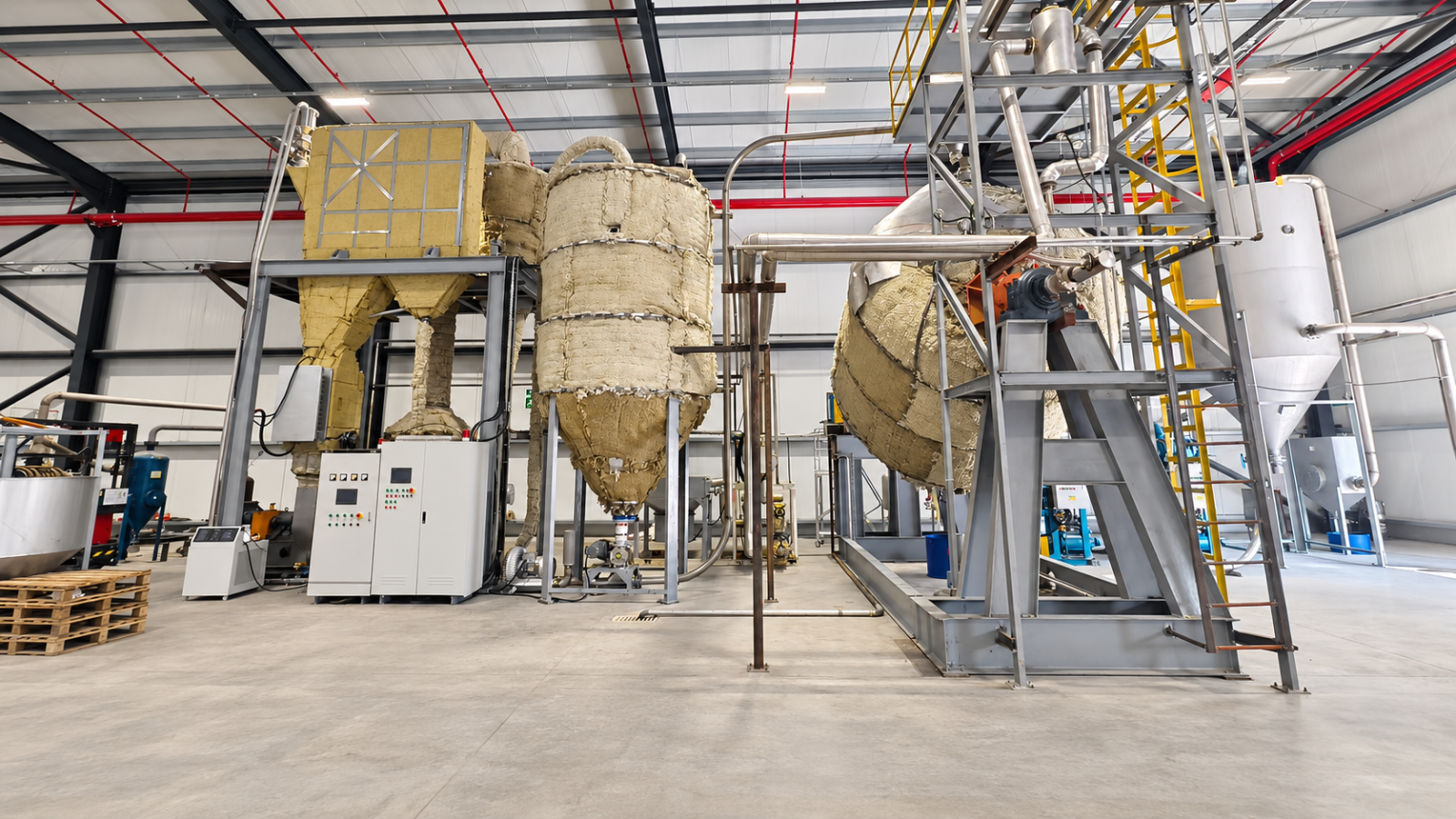
Equipment Supplied
800 kg/h Fluidized-Bed Pre-Crystallization and Drying System with 22 m³ Rotary Drum PET SSP System
Project Overview
URIDGE supplied an integrated PET solid-state polycondensation (SSP) system for a PET yarn producer in Bursa, Turkey. The project combines an 800 kg/h fluidized-bed pre-crystallization and drying system with a 22 m³ rotary drum SSP unit. It was designed to process recycled PET chips in batches of approximately 9–10 tonnes and increase the material's intrinsic viscosity (IV) to 1.10 dL/g for yarn and filament production.
The equipment was installed and commissioned in August 2026 and entered normal production. By pre-crystallizing and drying the recycled PET chips before they enter the SSP drum, the project reduced the complete batch-processing cycle from approximately 32 hours to 24 hours under the customer's operating conditions.
Customer Requirements
The customer operates in the PET yarn industry and required a reliable route for upgrading recycled PET chips to a higher and more stable intrinsic viscosity. The main technical questions concerned the achievable IV, the energy required per tonne and how a batch rotary SSP system could reduce operating costs compared with a conventional configuration.
URIDGE configured the project around three practical targets:
- Increase recycled PET to an IV of 1.10 dL/g for the customer's yarn-production application.
- Process 9–10 tonnes of PET chips in each batch.
- Reduce batch time and specific energy consumption through pre-crystallization, effective drying and improved thermal-oil heat transfer.
Main Project Specifications
| Project Location | Bursa, Turkey |
|---|---|
| Customer Industry | PET yarn and filament production |
| Raw Material | Recycled PET chips |
| Target Intrinsic Viscosity | 1.10 dL/g |
| Pre-Crystallization Capacity | 800 kg/h |
| SSP Drum Volume | 22 m³ |
| Batch Loading | Approximately 9–10 tonnes per batch |
| Complete Process Time | Reduced from approximately 32 hours to 24 hours for this project |
| Specific Energy Consumption | Approximately 260 kWh/t under the agreed project conditions |
| Installation and Commissioning | August 2026 |
Integrated Pre-Crystallization, Drying and SSP Process
The project uses a two-stage arrangement. Recycled PET chips first enter the 800 kg/h fluidized-bed system for controlled pre-crystallization and drying. The conditioned material is then transferred to the 22 m³ rotary drum for solid-state polycondensation.
1. Fluidized-Bed Pre-Crystallization and Drying
Pre-crystallization helps prevent PET chips from sticking together when they are exposed to the higher temperatures required by the SSP stage. Drying also reduces residual moisture before the material enters the drum. Treating the chips continuously at up to 800 kg/h allows the rotary SSP unit to receive material that is already prepared for the viscosity-increasing reaction.
2. Rotary Drum Solid-State Polycondensation
Inside the 22 m³ rotary drum, the PET remains below its melting temperature while controlled heat, pressure and residence time promote further polycondensation. The rotating drum supports material movement and more uniform exposure to the process conditions. For this Bursa installation, each batch carries approximately 9–10 tonnes of recycled PET chips.
3. Target IV for Yarn Production
The system was configured to raise the recycled PET to an IV of 1.10 dL/g for the customer's PET yarn application. The same SSP principle can also be configured for lower target values, such as approximately 0.84 dL/g for suitable bottle-preform applications, subject to the starting material, process recipe and final-product requirements.
How Pre-Crystallization Reduced the Batch Cycle
In a conventional batch arrangement, crystallization and moisture removal may consume a substantial portion of the time inside the main SSP vessel. This project moves those preparation steps to the dedicated fluidized-bed system before the chips are loaded into the rotary drum.
Because the incoming chips are already crystallized and dried, more of the drum cycle can be devoted to the viscosity-increasing stage. Under the customer's project conditions, the complete processing time was reduced from approximately 32 hours to 24 hours. This represents a 25% reduction in cycle time and improves the effective output available from each batch.
Half-Pipe Thermal-Oil Heating Design
A key feature of the URIDGE rotary SSP drum is its half-pipe thermal-oil heating structure. The thermal-oil channels are integrated directly with the drum shell, creating a defined circulation path around the heated surface. This design improves contact between the heat-transfer circuit and the drum body, helping transfer heat to the PET more efficiently and uniformly.
Compared with a conventional batch rotary SSP configuration under comparable operating conditions, this heating design is intended to reduce electrical energy consumption by approximately 30%. For the Bursa project, the estimated specific energy consumption to reach the required target IV is approximately 260 kWh per tonne.
Actual cycle time and energy consumption depend on the starting IV, target IV, moisture level, batch loading, utility conditions, insulation condition and operating recipe. The values above describe this project's design and operating conditions rather than a universal guarantee for every PET feedstock.
Customer Questions Answered
How high can the PET intrinsic viscosity be increased?
The required target depends on the downstream application. A system can be configured for an IV around 0.84 dL/g for suitable bottle-preform production or up to 1.10 dL/g for demanding yarn and spinning applications. This Bursa project was designed for a final IV of 1.10 dL/g.
How much energy is required per tonne?
For this project, the estimated specific energy consumption is approximately 260 kWh/t when processing the agreed recycled PET material to the target IV. Feedstock condition and the selected operating recipe influence the final figure.
Why is the energy demand lower than that of a traditional batch drum?
The upstream pre-crystallization and drying system reduces the work required inside the SSP drum. The integrated half-pipe thermal-oil channels also define the oil-flow path and improve heat transfer through the drum shell. Together, these measures shorten the process cycle and reduce unnecessary energy use.
URIDGE Equipment and Service Scope
- Process assessment for recycled PET chips and yarn-grade IV requirements
- 800 kg/h fluidized-bed pre-crystallization and drying system
- 22 m³ rotary drum PET SSP system
- Thermal-oil heating and circulation system
- Material-transfer and process connection design
- Electrical control and process-monitoring system
- Equipment manufacturing, assembly and factory preparation
- On-site installation guidance, commissioning and operator support
Installation and Operating Result
The integrated PET SSP system was installed and commissioned in Bursa in August 2026. After commissioning, the equipment entered normal production and achieved the customer's operating target for recycled PET chips used in yarn manufacturing.
The project demonstrates how a dedicated pre-crystallization stage, a large rotary SSP drum and an efficient thermal-oil heating structure can work together to increase PET intrinsic viscosity while improving batch productivity and controlling energy consumption.
Related PET SSP Equipment
Learn more about the configurable URIDGE SSP Solid-State Viscosity Increasing Equipment for PET Recycling. Capacity, vessel volume, target IV and process configuration are selected according to the incoming PET material and the customer's downstream application.
Planning a similar line?
Discuss Your Project